The new issue of the Compton Chronicle has now been published online and will be delivered in hard copy shortly:
Category Archives: News
Moment of Reflection, 18 September 8 pm
Avon Dassett
A Moment of Reflection on the Eve of the Funeral of
Her late Majesty Queen Elizabeth II
Sunday 18 September at 8 pm
The parish council are leading the community moment of reflection.
By 19.55 members of the community will gather at the War Memorial.
At 20.00 a whistle sounds
Silence will be kept
At 20.01 the whistle marks the end of the Silence
Applause
The Proclamation of The King’s Accession will be read
The vigil concludes with all present saying:
God Save The King
and the singing of the National Anthem
-o0o-
Death of Queen Elizabeth II – Local Arrangements
An update on arrangements following the death of Queen Elizabeth II and the accession of King Charles III.
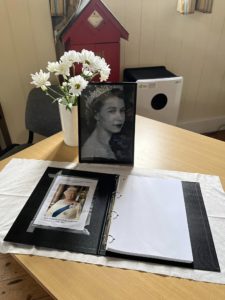
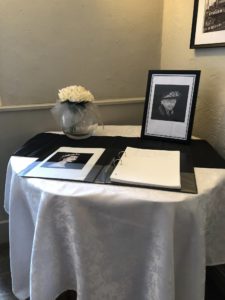
Books of Condolence are available to sign in The Yew Tree (during opening hours) and the Reading Room (8am-8pm on Wednesday 14 September)
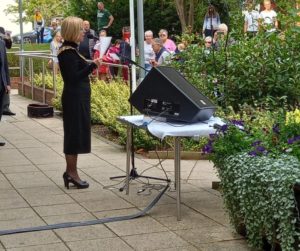
The Proclamation on the Accession of Charles III was read locally in Southam and surrounding villages.
Local church services to commemorate the life of the Queen will be held as below:
- Tuesday 13 September at 7pm – Farnborough
- Wednesday 14 September at 7pm – Northend
- Thursday 15 September at 7pm – Fenny Compton
- Sunday 18 September at 10 am – Burton Dassett
There will be a National Moment of Reflection marked by a minute’s silence on the eve of the Queen’s funeral at 8 pm on Sunday 18 September.
The funeral will be broadcast at The Yew Tree on Monday 19 September.
Parish Council Statement

The parish council have made the following statement:
It is with great sadness and with a heavy heart that we hear of the death of Her Majesty Queen Elizabeth II on 8 September 2022.
Avon Dassett Parish Council send their condolences to the Royal Family at this sad time.
The official website of the Royal Family has updated following the death of the Queen, with King Charles III listed as His Majesty The King.
A book of condolences has been opened for people to sign online.
Mourners can visit the Royal website at https://www.royal.uk to leave their messages. The website states that a selection of the notes will be passed on to the Royal Family.
Local Arrangements
Books of Condolence
Avon Dassett Parish Council will have a book of condolence in the Yew Tree during opening hours from 5pm this evening.
Avon Dassett will also have a book of condolence at the Reading Room during Post Office opening hours and each Wednesday from 8am to 8pm.
Residents who are unable to visit these locations or who or would prefer can send a word document to our clerk at:
clerk@avondassettparishcouncil.com
and these will be printed and inserted into the book of condolence.
Flowers or Wreaths
Anyone wishing to lay a wreath or flowers can do so at the village war memorial.
We do ask that cellophane is removed.
All flowers and wreaths will be removed after the funeral as per protocol.
Jo Jarman
Clerk and Responsible Financial Officer
Avon Dassett Parish Council
Their website is: http://www.avondassettparishcouncil.com
Death of Queen Elizabeth II 1926-2022
Avon Dassett joins with communities across Britain, the Commonwealth and the world in mourning the death of Queen Elizabeth II.
The funeral is expected to be on 19 September 2022.

Village Coffee Morning 7 September 2022
Village Coffee Morning for Macmillan Cancer Support
This month’s village coffee morning TOMORROW will be supporting Macmillan Coffee Morning, so as well as the usual donation pot, there will be a raffle and a Bring & Buy.
All being well, we should also get the Warwickshire Firemen here to talk about fire safety in the home, including smoke alarms, and they will be able to arrange to call in homes to inspect old/ refit new ones – for free.
Wednesday 7th September – 11am to 12:30pm – The Reading Room – Free entry – Everyone welcome
Household Support Fund
Frequently Asked Questions (August 2022)
What is the Household Support Fund?
The government has made available £421 million to the Household Support Fund (HSF) to be shared amongst local authorities in England to provide targeted financial support for those most in need of help with significantly rising living costs. The Fund will support vulnerable households, particularly those including children and pensioners, to ensure that people have the support they need to afford food, energy, water bills and associated costs. More information is available at: https://www.gov.uk/government/publications/household-support-fund-guidance-for-local-councils
What is it for?
The Household Support Fund is to provide support to vulnerable households, particularly families with children and pensioners, affected by significantly rising living costs where alternative sources of assistance may be unavailable.
How much was Warwickshire allocated and on what basis?
Warwickshire’s allocation is £3.47m to cover the period 01 April 2022 to 30 September 2022. Funding has been allocated by population, weighted for the Index of Multiple Deprivation.
What can the funding be used for?
The conditions of the grant mean that the funding cannot be used for the provision of general advice on managing debt and the type of support is ringfenced to provide support with food, energy and water bills or other essentials. Specifically,
• at least one third of the total funding must be allocated to support households with children,
• at least one third of the total funding must be allocated to support pensioners, and
• up to one third of the total funding to other households genuinely in need of support.
How is the HSF funding being distributed in Warwickshire?
Warwickshire County Council is distributing the funding via the Warwickshire Local Welfare Scheme and working with Districts and Boroughs to identify specific projects that can be supported within the scheme’s parameters. The council has proactively identified vulnerable families with children eligible for benefits related free school meals and residents in receipt of pension credit, who are automatically receiving vouchers towards food and fuel costs. Other vulnerable residents who are struggling financially can apply for support from the scheme or other sources by contacting the Local Welfare Scheme Team directly on 0800 4081448.
How can people find out about financial support available to them?
Warwickshire County Council’s webpages (www.warwickshire.gov.uk/localwelfarescheme and www.warwickshire.gov.uk/facinghardship) will be updated with details of support and messages will be sent out via the council’s Twitter (@Warwickshire_CC) and Facebook (@WarwickshireCountyCouncil) social media platforms. Information about food and financial support for those facing hardship will also be shared with schools and other education settings as well as public, community and voluntary sector partners to reach people in local communities who may benefit from this help.
Who can apply for financial support from the Local Welfare Scheme?
Please go to the website https://www.warwickshire.gov.uk/localwelfarescheme for the most up to date eligibility criteria. The additional funding has enabled some temporary changes to ensure flexibility when supporting our most vulnerable residents at times of unavoidable crisis when they have no other means of help
How can people apply for support?
Vulnerable residents who are struggling financially can apply for support from the scheme or other sources by contacting the Local Welfare Scheme Team directly on 0800 4081448.
Support & Advice for Energy Bills

Road Closure – 1 September 2022
TEMPORARY CLOSURE OF LOWER END, AVON DASSETT
Warwickshire County Council has made a Temporary Traffic Order details as indicated below:
| Effect of Order | Lower End closed to vehicular traffic |
| Reason for Order | To enable pole testing works. |
| Order Effective from: 1 September 2022 for up to 18 months 0or until works are completed, whichever is the sooner. | |
| Anticipated Completion Date: 1 September 2022. | |
| Access & Diversion: An alternative route will be signed and is available via: Church Hill, Avon Dassett Road, Dassett Road, Lower End and vice versa.
Vehicular access & egress will be maintained where possible |
|
| Contractor: Sunbelt Rentals Tel: 03700 500 792. | |
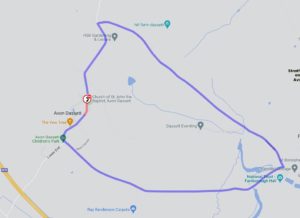
To report any problems with these works or for further details of our current & planned roadworks visit our website www.warwickshire.gov.uk/roadworksmap or call us 01926 412515.
New research van rolled out to detect dangerous driving
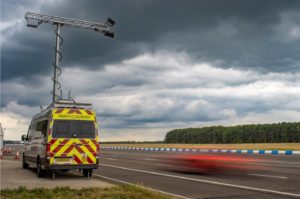
- A new van is being used to trial technology that can detect drivers holding a mobile phone at the wheel and people failing to wear a seatbelt
- It is being trialled in partnership with Warwickshire Police
- The van will also be able to detect tailgating vehicles in the future
New mobile technology capable of automatically detecting motorists who fail to wear a seatbelt or hold mobile phones at the wheel is being trialled in the UK for the first time under plans to boost road safety.
A new van packed with detection equipment has hit England’s motorways and major A-roads as part of a research project carried out alongside Warwickshire Police to understand the scale of the problem around these dangerous motoring offences. As part of this work, drivers will be sent warning letters in partnership with the police force, informing them of the dangers of their actions.
The ‘sensor test vehicle’ is equipped with multiple cameras which can record footage of passing motorists. Images captured by the cameras are processed using artificial intelligence (AI) to determine if motorists were using a handheld mobile phone and drivers and passengers were without a seat belt. The van is also capable of being kitted with additional technology to detect tailgating offences, although this system does not form part of the latest trials in Warwickshire.
The vehicle, which will be stationary at the side of the road while in use, is being trialled over a period of almost three months.
The warning letters, issued by police, will remind drivers that they could be fined up to £500 for not wearing a seat belt in addition to penalty points. Drivers will also be asked to complete a short survey which will be used to inform National Highways’ research. Using the technology in a van will allow National Highways to test it across different types of road to better understand driver behaviour across the network.
The van is initially being employed for a around three months. Findings will inform the next steps and any future deployment.
This research forms part of National Highways’ commitment to road safety as its number one priority. England’s motorways are already among the safest roads globally and the company has an ambitious strategy to further improve safety over the coming years. This includes a long-term commitment to cutting the number of people killed or seriously injured on the strategic road network to zero by 2040.
Government figures show that there were 420 collisions on British roads in 2019 in which the driver was using a mobile phone at the wheel. Separate figures show that failure to wear a seatbelt has been attributed to one in four road deaths.
National Highways Head of Road Safety Jeremy Phillips said:
“Safety remains our top priority and we want everyone to get to their destination safely. Sadly, there are still drivers who do not feel the need to wear a seatbelt, become distracted by their phones or travel too close to the vehicle in front. We want to see if we can change driver behaviour and therefore improve road safety for everyone. Our advice is clear; please leave enough space, buckle up and give the road your full attention.”
Dr Jamie Uff, Technical Director – Strategic Consultancy, Transportation, AECOM, said:
“Despite the often-reported dangers of distracted driving and failing to wear seat belts, the numbers of people killed or seriously injured as a result of these behaviours remain high. The technology AECOM is deploying makes detection straightforward and is providing valuable insight to the police and policy makers on the current level of road user behaviour. We are really keen to use this equipment to raise awareness and help improve road safety for all.”
Inspector Jem Mountford of Warwickshire Police said:
“We are really excited to see the impact that this new technology has on the behaviour of drivers in Warwickshire.
“Our officers deal with the tragic circumstances of collisions where often innocent people have been killed or seriously injured because a driver was distracted by a mobile phone or someone was not wearing a seatbelt. These collisions are preventable but we need all road users to do the right thing and comply with the law to make our roads safer.
“During the trial the most serious breaches may be prosecuted, with others receiving warning letters, giving us the opportunity to explain how they have been caught and asking them to change their behaviour. Next time they may not be so lucky.”
Around 25% of road deaths were linked to not wearing a seatbelt in 2018. In the same year, 117 people were killed or seriously injured in a collision where the driver was found to have been distracted. A recent trial of new static road side tailgating cameras on a stretch of the M1 captured 60,343 occasions of vehicles driving too close, in just one year.
The advice from National Highways is clear: leave plenty of space, buckle up and leave your phone alone.
Previous trials and other road safety
AECOM previously worked with Acusensus (road safety AI specialists) to trial a fixed camera that could detect drivers not wearing seatbelts and holding a mobile phone. The fixed camera was installed on the M4 in Berkshire last year and detected nearly 7,000 people failing to belt up and over 25,000 drivers holding their mobile phone in just six months.
It was the first time this technology has been used anywhere in the UK. The same system was deployed for the first time in New South Wales, Australia, in 2019. Over the last two years there has been a significant and sustained reduction in road fatalities compared with other states and territories in Australia.
Separately, National Highways trialled new tailgating cameras on a stretch of the M1 near Northampton. They captured 60,343 instances of vehicles driving too close in one year (October 2020 to September 2021).
Although the research is funded by National Highways, enforcement of motoring offences will remain a matter for individual police forces.
National Highways also operates three HGV cabs that are used by police to monitor driving on the strategic road network. Around 250 dangerous drivers a month are caught as part of the Operation Tramline programme, with handheld mobile phone use and not wearing seatbelts being some of the top offences identified by police.