
Dogs are now allowed to be walked in the parkland at Compton Verney. For more details see: https://www.comptonverney.org.uk/plan-your-visit/dogs-at-compton-verney/
Dogs are now allowed to be walked in the parkland at Compton Verney. For more details see: https://www.comptonverney.org.uk/plan-your-visit/dogs-at-compton-verney/
The Coventry Telegraph has reported that a Warwickshire dog has recently died from the virus known as Alabama Rot: https://www.coventrytelegraph.net/news/coventry-news/deadly-alabama-rot-disease-kills-17638015
Alabama dog rot is a disease that causes damage to a dog’s blood vessels and the kidney. It is a mysterious disease which is hard to identify and sadly, very difficult to treat. It can cause a dog’s skin to rot as it eats the flesh of the animal which makes it a particularly distressing disease.
Alabama dog rot was first identified amongst greyhounds in the state of Alabama in the 1980s. After this first flair up, the number of reported cases dwindled and as no clinical research was carried out, the disease was almost relegated to history. Because no one has been able to determine what causes the disease, it is now only recognisable by its collection of clinical symptoms. The scientific name for Alabama Rot is cutaneous and renal glomerular vasculopathy (CRGV).
Since the disease was first detected in 2012 in the UK the number of cases of Alabama dog rot in dogs has risen. The most serious outbreak was in the New Forest region of Hampshire but there have also been reported cases in several other counties, with the most recent cases reported Gloucestershire, Monmouthshire, Devon, Dorset, Cheshire, Warwickshire, Greater Manchester and Worcestershire.
There has been some speculation that walking dogs in particular areas of the countryside may be a contributing factor, but the Forestry Commission has yet to warn of any specific sites being dangerous, reassuring dog owners by saying “Many thousands of dogs are walked in the countryside every day and it is important to remember that only a very small number of dogs have been affected.”
There are no specific steps you can take to prevent your dog from contracting the disease, but there is some evidence of seasonal fluctuation, with most cases appearing between November and June. New advice suggests keeping your dog away from very muddy areas.
It is suspected the disease spreads from muddy and wooded areas – dog owners who do walk their dogs in these places are advised to wash off any mud as soon as possible, and of course, keep close control of their dogs at all times to monitor where they go.
Other pets, such as cats, guinea pigs or rabbits are not thought to be affected by Alabama Rot.
The first sign of Alabama Rot is skin sores that have not been caused by a physical injury. These sores can present as lesions, swelling, a patch of red skin, or may be open and ulcer-like. The sores are most commonly found below the knee or elbow or occasionally on the stomach or face. Usually, this will cause localised hair loss and the dog will begin licking the wound. These lesions will be followed – between two and seven days later – with outward symptoms of kidney failure: reduced appetite, fatigue, and vomiting.
Affected dogs will also develop signs of severe depression, loss of appetite and vomiting, quickly accompanied by acute injury to the kidneys.
The best outcomes seem to be achieved by catching it early and the animal receiving high-quality veterinary care. Whilst some infected dogs do survive the treatments of skin sores and kidney failure, unfortunately, many do not – it is estimated that treatment is only successful in around 20-30% of cases.
It is important, however, not to get overly worried by this as the percentage of dogs in the UK who have contracted this disease is truly minuscule. Though, what is vital, is that you understand the problem and know what to look out for, should your dog come into contact with it, as time plays a large part in successfully treating the disease.
The source of the disease is unknown, with the Environment Agency ruling out any chemical contamination in water supplies. Experts believe the disease is “very similar” to Alabama Rot, thought to be related to a toxin produced by E. Coli bacteria. However, no evidence of this has been found after no signs were shown on the infected dogs.

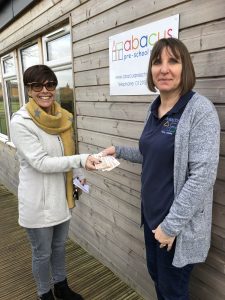
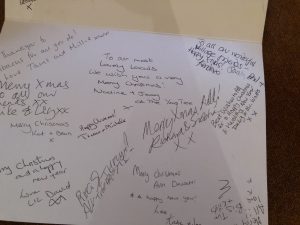
Delighted that the village Xmas card raised £60 for Abacus Pre-School in Fenny Compton. Sandra Sandiford popped in to deliver the money which will be spent on resources for the Pre-School. Thanks to everyone who donated!


The road from Avon Dassett to Farnborough will be closed for up to 10 days from 18-27 January due to works being carried out by BT. Diversions will be in place.
Severn Trent are undertaking repair and maintenance work near Spike Cottage, Avon Dassett on Thursday 16th January 2020. They are putting a temporary road closure in place from 14th January for no more than three working days. Access to frontages and parking may be restricted during this period.



4/5 January 2020 – power tools and a ride-on mower stolen from Farnborough (Incident 93 of 5/1/20)
3/4 January 2020 – quad bike, trailer and tools stolen from Little Kineton (incident 60 of 4/1/20)
1 January 2020 – burglary at Hurst Rd, Southam (incident 122 of 1/1/20)
19/20 December 2019 – horse trailer, chain saw, hedge cutter and hand tools stolen from Kinghtcote (incident 94 of 20/12/19)

WCC has made funds available to community and voluntary sector groups under the countywide health and wellbeing grants programme. South Warwickshire Clinical Commissioning Group has also provided additional funds for projects in South Warwickshire.
Groups can bid for funding from £5,000 to a maximum of £10,000 per initiative. Projects must be delivered in Warwickshire and need to address one or more of the following health and wellbeing priorities:
The online application opened on Wednesday 18 December 2019 and closes at 12 noon on Monday 3 February 2020.
Organisations are asked to submit an application online via www.csw-jets.co.uk. Once the application is live it can be viewed under ‘Tenders’ and found by searching either ‘WCC-8587’ or ‘Warwickshire Public Health Grant Funding’.
Support from Warwickshire Community and Voluntary Action (CAVA) is also available to voluntary and community groups with the application process. There is no cost for this support. Contact Tracy Southam, Mid Area Manager via tracy@wcava.org.uk if you require advice or support. WCAVA will be holding a grant application training workshop to support groups interested in applying for a grant. The workshop will be held in Rugby Borough on 20th January (am). Booking details will be available in the funding application.
Priorities for funding allocation have been identified following assessments of local health and wellbeing needs (Joint Strategic Needs Assessment, (JSNA)). Further information can be found here at https://www.warwickshire.gov.uk/joint-strategic-needs-assessments-1
For more information, contact: dphadmin@warwickshire.gov.uk
Applications open from 6 January 2020 so Don’t Delay Apply Today!
We’re going to be giving away £10million over the next five years to support local projects, charities and community groups in the Severn Trent region.
Our customers have helped us to create and shape our new community fund.
We’ve spoken to lots of you to better understand your community needs, and as a result, have chosen to design our fund around improving community wellbeing, namely:
Applications will open from 6 January 2020 via our website. Please see further details using the below link:
https://www.stwater.co.uk/about-us/severn-trent-community-fund/
Please note: In March, our first Community Fund Panel will meet and from April 2020 we will be giving out our first grants to local community projects.